

At the end of February, I knew it was coming.
You know that feeling when you’re working harder than you’ve ever worked, producing more than you’ve ever produced, and you can still see the writing on the wall? That was me for months leading into March 2025. No matter what I did, no matter how many wins I stacked up, it was just my time to go.
And when it finally happened? Relief.
Not excitement. Not fear. Just relief. Because the waiting was finally over, and I could stop pretending the outcome might be different.
But relief only lasts about two days when you don’t know how you’re going to pay your bills.
Fortunately, I have an incredible network. Within weeks, I landed a hybrid role (part program management, part product management). It wasn’t the pure product ownership I’d lost, but it let me lean into execution and delivery.
What I didn’t expect was how this shift would change my relationship with Product Party. My newsletter stopped being a side project. It became my laboratory. And as I started writing about career uncertainty and what happens when experienced tech professionals have to figure out what’s next, the audience responded because there are a lot of us navigating the same questions.
I wasn’t just writing for me anymore. I was writing for all of us.
So here’s how 2025 actually played out against what I said I’d do.
What I Said I’d Do (vs. What Actually Happened).
At the start of 2025, I set three clear goals:
Goal #1: Be more active in communities.
My Plan: Respond to comments thoughtfully, engage in product spaces, and maybe host a Q&A.
What Happened:
I definitely engaged more (sometimes a little too aggressively). I got banned from r/productmanagement for accidentally promoting my newsletter. Oops.
But I also discovered some incredible voices through Substack Notes, even if the sheer volume of automated content meant I had to actively hunt for the good stuff instead of algorithms surfacing it for me.
Grade: B (enthusiastic participation, minus points for the ban)
Goal #2: Focus on content strategy and consistency.
My Plan:
Publish one post per week
Complete at least 2 product deep dives
Maybe have a viral moment
What Happened:
I kept the one post per week commitment all year. Fifty-two posts published without missing a week, even through job loss and role transition.
The deep dives? Didn’t really materialize fully. I dabbled in covering some products…but something better happened.
In late February (right as I was processing my impending job loss), I published back-to-back posts: “Finding your way: modern tools for the modern job search” and “Practical ways I am using AI daily.”
They took off.
Suddenly, I wasn’t averaging 400 views per post anymore. I was regularly hitting 2,000+. My highest post this year reached 4,500 views.
I got picked up by Pendo.io and other product management aggregators. My content was reaching people far beyond my subscriber base, and they were engaging with it in ways I hadn’t seen before.
By the numbers:
Average views per post: 400 → 2,000+ (5x growth)
Highest single post: 4,500 views
Industry aggregator features: Multiple
I didn’t chase virality. I wrote from a place of genuine uncertainty about my own future, and thousands of others felt the same.
Grade: A (crushed consistency, exceeded reach goals, learned deep dives aren’t the only way to create impact)
Goal #3: Find my writing voice.
My Plan: Write like we’re sitting down for coffee, not delivering a presentation.
What Happened:
There’s a post I wrote called “Are you fulfilled by the work you are doing?”
I was expecting to get fired. I was questioning everything. And I wrote from that place of raw honesty about career crossroads and what it means to feel purposeful in your work.
That’s when I felt it click.
I stopped trying to sound like a product expert delivering insights and started writing like someone who’s been through some stuff and wants to share what I’ve learned.
Real examples from my own work. Frameworks I’ve actually tested. Honest reflections on what worked and what didn’t.
The engagement confirmed it. People replied with their own career anxieties. They shared the post with colleagues going through similar transitions. My content wasn’t just informative; it was engaging. It was connecting.
Grade: A (found the voice, and it resonated)
Unexpected Wins.
Some of the best things that happened in 2025 weren’t on my goal list at all.

I got my first sponsorship.
Chameleon reached out to test whether smaller, niche newsletters could drive traction for them. They gave me four sponsored posts to run, with complete control over duration and content.
It wasn’t life-changing money. But it was validation that what I was building had value beyond my own satisfaction. People were paying attention. Brands saw potential in this audience.
More importantly, it shifted how I thought about monetization. Product Party could actually generate revenue. Not enough to quit my day job, but enough to prove that sustained effort creates opportunities you can’t predict.

I shipped a production app.
In the middle of navigating job loss and a new role, I decided to finally tackle a 2025 goal I’d set for myself: understand mobile development by shipping something real.
I built Leafed (a book search app using React Native and Expo). It’s on both the Apple App Store and Google Play Store. Cost me about $175 and countless hours figuring out how to architect something that works across platforms.
The moment I got it live in production? That was the “oh sh*t, I actually know how to do this now” moment.
But the real learning wasn’t about code. It was about thinking at the right level of abstraction. When you’re both the product person AND the developer, you start appreciating the speed considerations and architectural decisions you used to take for granted.
I’ve always been able to design at scale and break down complex plans.
Now I can code them too. That changes everything about how I evaluate feasibility and scope.

I collaborated with people I respect.
Elena Calvillo at Product - (who writes the outstanding Product Release Notes) invited me to contribute to her AI Advent Calendar project.
It was one collaboration, but it showed me how much more powerful content becomes when you work with other creators who share your values and audience.
I want more of that in 2026.

What Didn’t Work.
Not everything was a win. Let’s be honest about what flopped.
LinkedIn and Bluesky engagement never materialized.
I started the year posting consistently across Substack, LinkedIn, and Bluesky. The hope was to meet readers where they already were and build engagement across platforms.
It didn’t work.
LinkedIn felt like shouting into a void of algorithm optimization and corporate speak. Bluesky was interesting, but never gained the traction I needed to justify the effort.
So I doubled down on Substack and put my energy where the audience was actually responding.
I rested on my laurels as a project manager.
Here’s the thing nobody tells you: your skills aren’t as portable as you think.
I’ve always been able to walk into any organization and get teams to deliver. It’s my superpower. But when I landed in my new hybrid role, I took for granted how much of that success came from context, relationships, and organizational knowledge.
You can’t just show up and expect people to follow you. You have to rebuild trust. You have to understand the new system. And you have to be way more detailed in how you communicate, both to appease stakeholders and to get the most out of teams who don’t yet know you.
It was humbling. But it made me better.
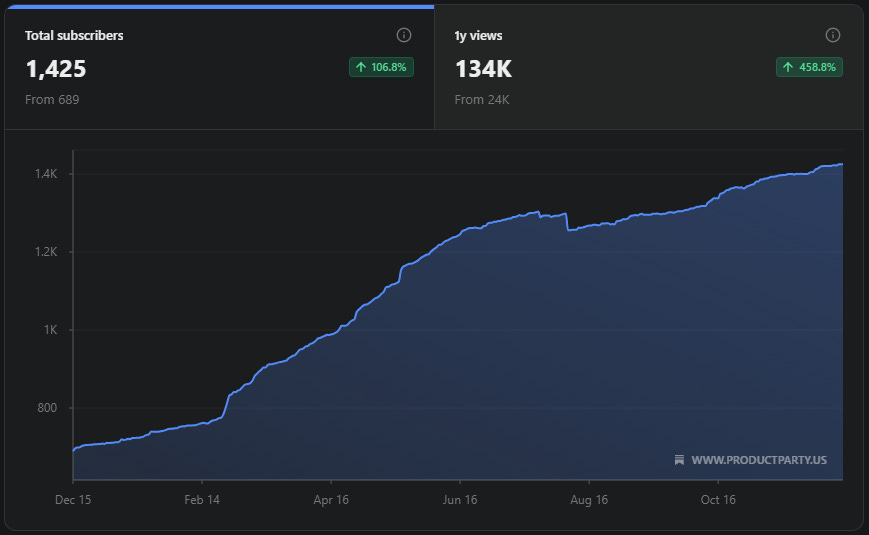
Numbers That Matter.
Let’s talk growth.
Subscribers:
January 1, 2025: 710
November 17, 2025: 1,398
Projected end of year: 1,420+ (100% growth)
Engagement:
Average views per post: 400 → 2,000+ (5x growth)
Highest single post: 4,500 views
Open rates: Consistently 29-31% (well above industry average)
Posts published: 52 (maintained 1 per week for the entire year)
Revenue generated: First sponsorship partnership (Chameleon, four posts)
Apps shipped: 1 (Leafed, available on iOS and Android)

What 2025 Taught Me.
I started this year thinking I needed to be more active, more consistent, more strategic.
What I learned is that the best content comes from lived experience. From writing through uncertainty instead of waiting until you have all the answers.
I learned that technical skills compound faster than you expect when you commit to actually building something.
I learned that losing a job doesn’t mean losing momentum. It can actually force you to clarify what matters and where you want to invest your energy.
And I learned that there’s an entire community of mid-career tech professionals navigating the same questions I am. We’re not looking for generic startup advice. We’re looking for honest reflections from people who’ve been through it.
That’s what Product Party became in 2025. Not just a newsletter about product management frameworks, but a space for honest conversations about navigating careers in flux.
What’s Next for Product Party in 2026.
I’m not interested in setting goals to check boxes anymore. 2025 taught me that the most meaningful progress comes from committing to things that actually matter.
Here’s what I’m building toward:
1. Content Evolution: “How I’d Solve This.”
I’ve spent enough time analyzing what other companies do. In 2026, I want to shift to showing how I’d actually approach specific product challenges.
Less observation. More applications.
Measurable targets:
Hit at least one post with 10,000+ views
Average 4,000 views per post
2. Strategic Collaborations.
The Elena Calvillo at Product collaboration taught me that creating in isolation has a ceiling. When I contributed to her AI Advent Calendar, I wasn’t just writing for my audience. I was part of something bigger, and it forced me to think differently.
Target: Partner with 3 product creators in 2026 for guest posts, co-created content, or joint analysis.
Not transactional follower swaps. Real collaborations where we’re wrestling with a problem together and the combined output is meaningfully better than what either of us would produce alone.
3. Technical Impact: Build for Good.
I proved I can ship a production app. Now I want to use those skills for something beyond personal learning projects.
Dual-track approach:
Ship an app (mobile or web) that generates at least $1 in revenue
Contribute software to the non-profit community
I see many non-profits seeking help understanding how to use AI effectively. Maybe I can build a platform that levels them up quickly. Perhaps it’s something else. Either way, I want to use my skills for mission-driven work.
4. Sustainable Monetization.
The Chameleon sponsorship proved that people are willing to pay to reach this audience. Now I want to build recurring revenue streams.
Target: Average $100/month from combined sources
Affiliate links (ClickUp, Monday.com, productivity tools)
Sponsorships
Potential paid offerings (templates, toolkits, deep-dives)
This isn’t about quitting my day job. It’s about validating that Product Party creates real, sustainable value.
5. Growth Targets.
Numbers matter, but only when they represent real people finding value in what you’re building.
Subscribers: 1,420 → 3,000 (111% growth, ~132 new subscribers per month)
Engagement: Maintain 29-31% open rates while growing reach
I’m not chasing vanity metrics. I want 3,000 people who actually open these emails, who reply with their own career questions, who forward posts to colleagues facing similar challenges.
Growth that reflects genuine connection, not just algorithmic luck.
Closing Thoughts.
If you’d told me in January that I’d lose my job, ship a production app, double my subscriber base, get my first sponsorship, and completely redefine what Product Party means to me, I would’ve thought you were describing someone else’s year.
But that’s exactly what happened.
2025 was the year I learned what happens when the floor drops out, and you build something anyway.
Not because you have a perfect plan. Not because you’re sure it’ll work. But because you’re committed to showing up, trying things, and sharing what you learn along the way.
I’m incredibly grateful you’ve been part of this journey. Whether you’ve been here since the beginning or you just subscribed yesterday, thank you for reading, engaging, and being part of this community.
Here’s to 2026 (the year we turn consistency into impact, voice into value, and skills into solutions).
Until next year,
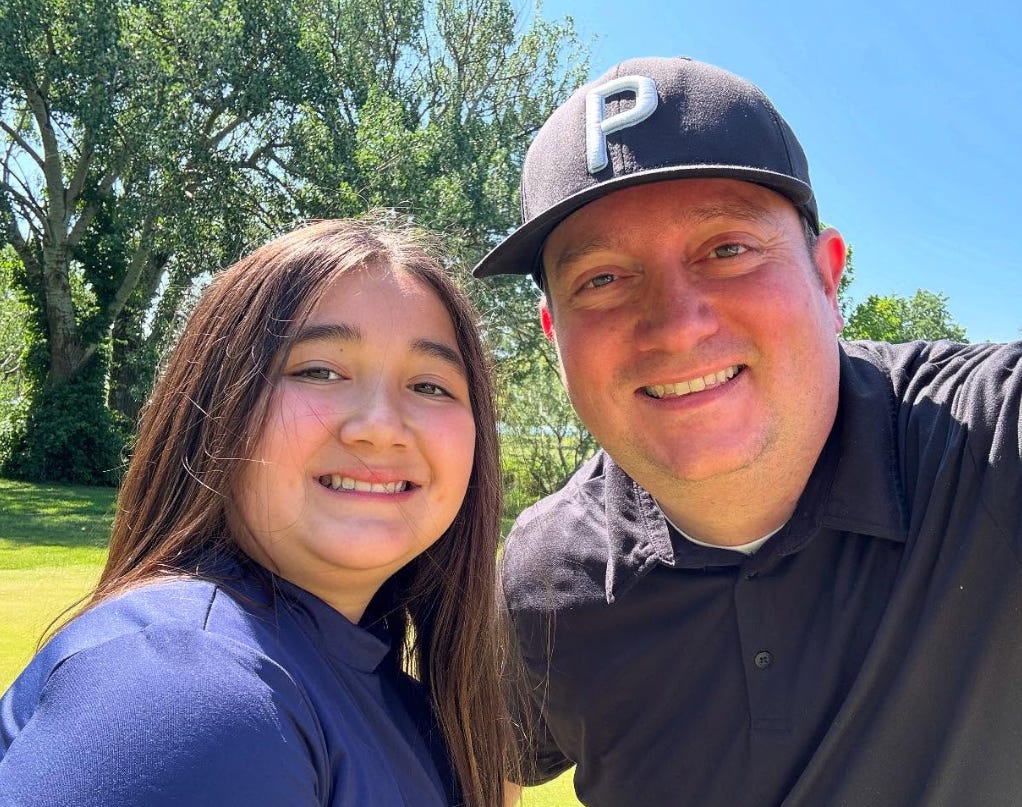
Mike Watson (pictured with my daughter and the real MVP, Leah)
Also - I made a new logo and color scheme. Let me know what you think!

PS: What are you building toward in 2026? I’d love to hear what you’re working on. Drop a comment below or send me a note.
Thanks for reading! If you haven’t already, please like, comment, share, and subscribe. You can also show your support by buying me a coffee.
Thoughtful and inspiring post!
Really inspiring review, Mike. Happy New Year, and hope you exceed all the goals you set! 🙂